
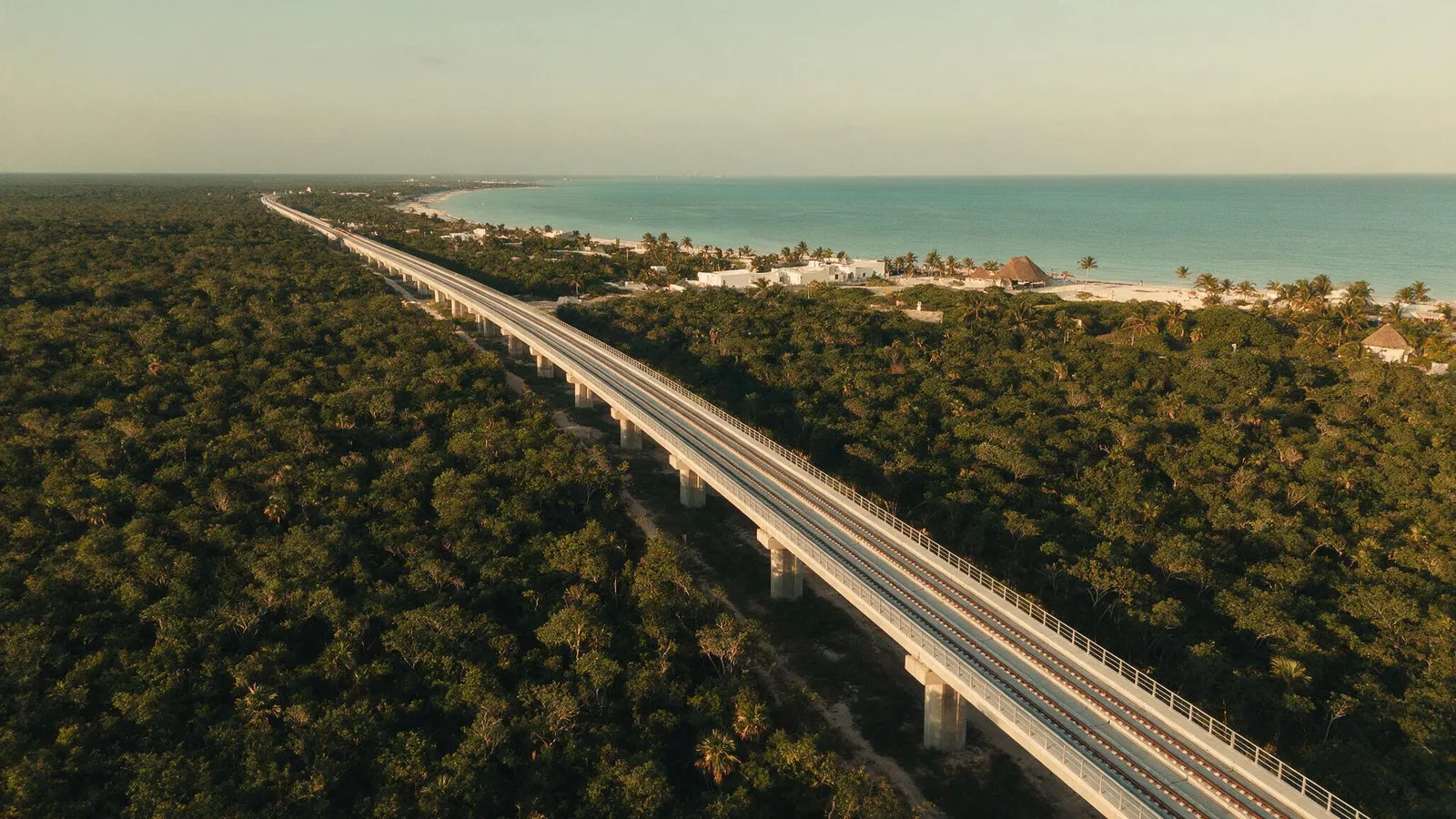
Nearly every guide ranking for "Mayan Train property values" closes on the same thing: a percentage. We read the ones at the top before writing this. One of the most visible, Dvelopers, cites up to 25% annual growth in land value and 18% to 35% appreciation in Yucatán, for lots within a five to fifteen kilometer radius of the main stations. It names Fonatur, INEGI and the Yucatán cadastre as sources, but it never says which of the three supports which figure, on what sample, by what method, or over what dates. Other pages publish different ranges for the same question with no source at all.
The interesting part is that they contradict each other. Everything Playa del Carmen, another of the English pages that rank here, argues the opposite: that the Tulum airport and the two stations in that area have added little to prices. Two incompatible claims, both on page one.
We do not have a better percentage to offer. We have something duller and considerably more useful: what can actually be checked in August 2026, from published timetables, official fares and passenger statistics. With that you can judge for yourself how much real connectivity your property is buying.
The percentage everyone quotes and nobody breaks down
An infrastructure appreciation claim has three parts that almost never appear together: what was measured (land, new construction, resale), over what period, and inside what boundary. Without all three the number means nothing. A 25% annual gain in land value can be true in one specific ejido that got urbanized, and false two hundred meters away. And a range calculated in Yucatán, around stations in a different urban context, does not transfer to the Quintana Roo coast by analogy.
There is a deeper reason to be skeptical. In the Riviera Maya, preconstruction list prices are set by the developer, not by a market with public transactions. There is no open registry of closing prices here that would let anyone compute appreciation the way it is done in other countries. When someone publishes a yield table by neighborhood, they are almost always averaging asking prices, which is exactly where optimism lives. We go into this in our guide to the areas of Playa del Carmen.
So the rest of this guide does not argue about percentages. It looks at the infrastructure.
What actually runs in the corridor today
Passenger service between Cancún and Playa del Carmen had been interrupted and resumes on August 15, 2026. According to the Quintana Roo state government announcement, reported by Por Esto! on August 9, the route returns with two morning departures in each direction: Cancún to Playa del Carmen at 6:45 arriving 7:34, and 10:30 arriving 11:19. Playa del Carmen to Cancún at 7:47 arriving 8:40, and 12:00 arriving 12:53. That is 49 minutes southbound and 53 northbound.
Tourist class fares, published by Infobae, run from 74 pesos on the special tariff (locals, students and INAPAM cardholders) to 99 pesos for accredited local residents, 148 for national travelers and 197 for international ones. The train applies dynamic pricing, so treat those as reference figures; the final fare depends on booking lead time and demand, and shows up in the reservations portal.
Read that timetable slowly, because that is the point. Two morning departures in each direction serve a planned trip. Commuter rail needs a different frequency and, above all, a late afternoon return, which this schedule does not have. That leaves hanging the pitch you hear most often in sales offices, the one about living in Playa and working in Cancún during the week. It may become true later. Today it is not, and the distance between what exists and what is announced is what will or will not pay for your apartment.
The station sits six kilometers from downtown, and that is only now changing
The Playa del Carmen station is not on Fifth Avenue. It is roughly six kilometers from downtown, and until now the practical way to reach it was a taxi. That distance has kept it occasional travel infrastructure, off to the side of daily life in the city.
What changes on August 15 is not only that the train comes back. Tren Maya Conecta also launches, the intermodal service linking stations to points around the city. According to the same state government release, two routes will operate in Playa del Carmen: station to Plaza Playacar, stopping at Plaza Quinta Alegría, Plaza 28 de Julio and the tourist assistance center known as CAPTA, and station to the Mayan hotel zone directly.
To us that announcement weighs more than any appreciation percentage, and it is worth explaining why. A station disconnected from the urban fabric moves tourists two or three times a week and little else. A station with reliable intermodal service starts changing real travel times, and travel times do show up in prices. The question worth asking six months from now is whether those routes are still running at the frequency that was announced.
Tulum airport: 1.24 million passengers and a contraction
This is where the sales pitch diverges most from the data.
Felipe Carrillo Puerto International Airport in Tulum closed 2025 with just over 1.24 million passengers, according to figures from Mexico's Federal Civil Aviation Agency. It was its second full year of operation and it landed slightly above the 1.233 million recorded in 2024. That is the part of the story you get told.
What happened next is rarely mentioned. According to reporting by Tulum Times using data from the same agency, international traffic fell 34% between January and April of 2026 against the same period of 2025. International destinations went from twelve in 2024 to four in 2026, and daily international departures dropped from ten to three. Avianca, Copa Airlines, JetBlue and Volaris Costa Rica suspended service there. The direct flights to JFK and Newark were lost. Four direct US routes remain: Atlanta, Dallas, Houston and Miami.
It is worth holding both things at once, without settling on the convenient one. The airport exists, it operates, and it brought Tulum closer for anyone arriving by air. Its international connectivity has also shrunk to a third of the daily departures it once had, on a 2026 trend pointing down. If your investment thesis depends on that airport filling Tulum with visitors, the variable to check periodically is the departures board.
Cancún, for scale
One figure puts all of the above in perspective. Cancún airport handled 29,345,538 passengers in 2025, according to figures published by 24 Horas Quintana Roo in January 2026. Cancún was down that year too, by 3.5%, a little over a million travelers fewer than in 2024.
In other words: Tulum moves around four percent of what Cancún moves, and both are trending down. Air connectivity in the Riviera Maya is still, in practice, Cancún's connectivity. Property here is still sold, rented and visited from that airport.
The Section 5 works are under a court suspension
There is a legal dimension no investment guide mentions, and it changes how you should read construction timelines.
A court granted a definitive suspension against the works on Section 5, the stretch running from Cancún to Tulum across the whole Riviera Maya. El Financiero reported the scope of the order in February 2026, and the nuance matters: a definitive suspension does not mean canceling the works, it means ordering verification, inspection, conservation and protection of natural resources while they proceed.
For a buyer the practical reading is this: in this corridor, an announced phase is not a dated phase. Between the announcement and actual operation sit permits, environmental litigation and annual budgets. If someone is selling you a unit on the strength of works that are not yet running, what you are buying is the announcement.
What infrastructure does change, and what it does not
After working closings in Playa del Carmen, Tulum and Cozumel, this is how we read it.
Infrastructure changes access. Access changes use demand, meaning who wants to be there and how often. That demand, sustained over time, is what can eventually reach price. That is three links and each one takes time. Skipping the two in the middle is exactly what those appreciation tables by neighborhood do.
In the closings we handle, the train comes up in conversation often and almost never decides the purchase. What decides it is more grounded: the real drive time, the maintenance fee, the condominium bylaws and whether the building allows short term rental. A client buying to live asks about schools and the supermarket. A client buying to rent asks about occupancy in the building next door. Neither has ever signed because of a train timetable.
And there is an asymmetry worth saying out loud: heavy infrastructure brings better access, and it also brings years of construction, traffic and pressure on local services. That is part of the package too.
How to verify an infrastructure promise before you sign
If a unit is being sold to you on connectivity, these four checks take under an hour and they are the same ones we run.
- Find the published timetable, not the map. A station map says nothing about frequency. Go to trenmaya.gob.mx, open the timetable for the segment you care about and check the price in the reservations portal. If there is no return train at the hour you would return, that trip does not exist for your life.
- Measure the distance from the property to the station and how you cover it. Measure it by car, by taxi or on the intermodal route, at a real peak hour. Six kilometers in high season traffic feel very different on the map than in the seat.
- Check passenger statistics, not press releases. Federal Civil Aviation Agency figures are public and show the trend. An airport losing routes is a different data point from one adding them.
- Separate built, operating and announced. And ask whether the phase carries a court suspension or an injunction. For the Section 5 works in 2026, the answer is yes.
When we tell someone not to buy for the train
We say no when the numbers only work if the infrastructure promise lands, or when the projected return depends on a phase that is not operating. Also when the buyer is paying a premium for proximity to a station that today has two morning departures. And when the entire thesis is the Tulum airport, without knowing it lost eight international destinations in two years.
We say yes, calmly, when the property stands up without the train. If the unit works on location, on the building, on the fee, on its bylaws and on demand that already exists today, then the infrastructure is what it should be: a factor in favor, not the argument.
BUZZ, on Calle 28 in Playa del Carmen, starts at 2,000,000 pesos, and we also have RAXÁ in Tulum and THE STELLA in Cozumel. If you are evaluating a specific unit for its proximity to a station, we are glad to measure the real commute with you and check whether the numbers hold without that assumption. You can browse inventory under properties or write to us from contact. If you are starting out, our preconstruction guide and the one on whether Tulum is a safe investment cover the ground before this.
This guide is informational. The timetables, fares and statistics cited are as of August 2026 and do change; always verify against the official source on the date you decide.